
Finding new customers who actually convert is one of the hardest parts of paid advertising. You can pour budget into broad targeting and hope the right people notice, or you can point your ads at prospects who already share the traits of your best buyers. That second approach is exactly what a look-alike audience delivers.
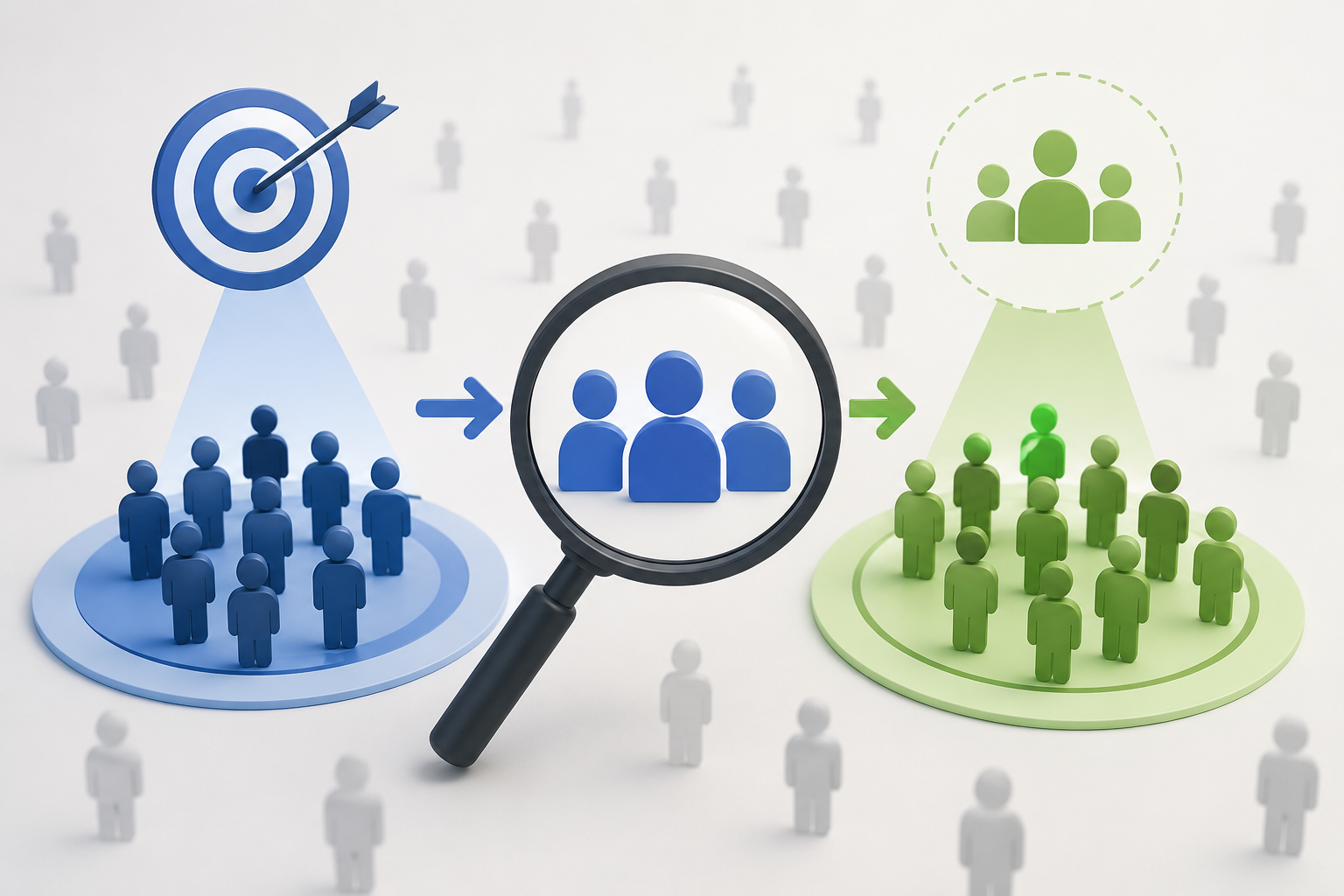
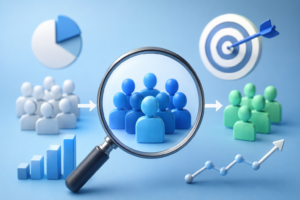
A look-alike audience is a group of new prospects who closely resemble your existing customers. Instead of guessing at interests and demographics, you let an advertising platform study the people who already buy from you, then find fresh audiences that match their patterns. It’s one of the most effective ways to scale customer acquisition without wasting spend on people unlikely to convert.
At Media Components, we build and manage look-alike targeting as part of our social media marketing and paid advertising programs for clients across the United States. This guide explains what a look-alike audience is, how it works, and how to create one that consistently reaches high-value customers.
Key Takeaways
- A look-alike audience is a set of new prospects who share characteristics with your existing customers, identified by an advertising platform’s algorithm.
- Quality starts with your seed audience – the source list of your best customers that the platform uses as a model.
- Platforms have evolved. Meta still offers look-alike audiences, but increasingly blends them into AI-driven Advantage+ targeting, while Google retired its Similar Audiences in favor of Customer Match and automated optimization.
- Similarity size is a trade-off. Tighter audiences match your customers more closely; broader ones reach more people with less precision.
- First-party data is the biggest lever. The cleaner and higher-value your source data, the better your results, whichever platform you use.
How Look-Alike Audiences Work
The concept behind look-alike targeting is simple, even if the technology behind it is sophisticated. You give an advertising platform a sample of people you already value – say, your paying customers or your highest-spending buyers. The platform’s algorithm analyzes that group across hundreds of data points, from behavior and interests to demographics and purchase patterns. It then searches its massive user base to find people who share those traits but aren’t yet your customers.
The result is a new audience that “looks like” your best customers, ready to be served ads. Because the targeting is built on real signals from real buyers, look-alike audiences tend to convert better than broad, interest-based targeting alone. They’re a powerful tool for scaling campaigns and reaching new prospects efficiently.
Source Data and Seed Audiences
Everything hinges on the source data, often called the seed audience. This is the list of existing customers or contacts the platform studies to build its model. Common seed sources include:
- Customer lists from your CRM, such as purchasers or high-value clients.
- Website visitors captured by a tracking pixel, especially people who took key actions like adding to cart or completing a purchase.
- Engagement audiences, such as people who watched your videos, followed your page, or interacted with your content.
- Lead lists gathered from forms, downloads, or sign-ups.
The principle here is straightforward: the algorithm can only find people who resemble the examples you give it. A seed audience built from your most valuable, most engaged customers produces a far stronger look-alike than one built from a broad, unfiltered list. Quality in means quality out.
Platforms That Use Look-Alike Targeting
Look-alike modeling exists across most major advertising ecosystems, though the exact names and mechanics differ – and they’ve changed meaningfully in recent years.
Facebook and Other Advertising Platforms
Facebook, now part of Meta, popularized the concept with its Lookalike Audiences feature across Facebook and Instagram, and it remains the platform most associated with the tactic. You can still create look-alike audiences on Meta today. However, the way they’re used has shifted. Meta has folded its older lookalike expansion into an Advantage+ audience feature, and its own guidance increasingly points advertisers toward AI-driven targeting rather than static, hand-built lookalikes. In practice, that means the strongest move on Meta in 2026 is often to feed your first-party customer list in as a signal and let the system find more people like them, since the algorithm now does the similarity modeling internally on richer data. Ads UploaderAds Uploader
Other platforms have taken their own paths:
- Google offered a similar tool called Similar Audiences, but it retired that feature across Search, Display, and YouTube in 2023, replacing it with Customer Match seed-based optimization and automated audience expansion. Adlibrary
- TikTok, LinkedIn, and Pinterest each provide their own versions of look-alike or “similar audience” targeting, letting advertisers scale from a source list of existing customers or engagers.
The takeaway is that look-alike modeling is alive and well as a concept – it’s simply becoming more automated. Increasingly, platforms handle the similarity math for you, and your job is to supply the highest-quality source data possible. Understanding how each platform now approaches this is exactly where an experienced advertising partner adds value.
How to Create a Look-Alike Audience
While the exact steps vary by platform, the process follows a consistent pattern. Getting each stage right is what separates a look-alike audience that quietly drains budget from one that reliably brings in new customers. Because look-alike targeting sits at the heart of effective paid campaigns, it’s a core part of how we structure PPC campaigns for our clients.
Here’s the general workflow:
- Set up tracking and data collection. Install the platform’s pixel on your website and connect your CRM or customer list so you have clean source data to work with.
- Choose your seed audience. Select the group of existing customers or engagers you want the platform to model.
- Create the look-alike audience. In your ad account, point the platform to your seed source and let it build the model.
- Set the size and location. Choose how closely the audience should match your source and which markets to target.
- Launch and monitor. Run your campaign, watch performance closely, and refine over time based on real conversion data.
Choosing the Right Seed Audience
Your seed audience is the single most important decision in this process. A larger source list generally gives the algorithm more to learn from, but relevance matters more than raw size. A tightly defined list of your highest-value customers usually outperforms a big, generic one.
Strong seed audiences tend to be:
- Specific to a goal, such as recent purchasers if you want more sales, or qualified leads if you want more inquiries.
- High-value, focused on your best customers rather than every contact you have.
- Large enough to be useful – most platforms recommend a source of at least a thousand people, though quality still comes first.
- Fresh and up to date, since your best customers today are a better model than a list from three years ago.
For most businesses, the top segment of customers by lifetime value or purchase frequency makes an excellent seed. It teaches the algorithm to look for more people like your most profitable buyers.
Optimizing Audience Similarity and Size
Once you’ve chosen your seed, you’ll set how closely the new audience should mirror it. On Meta, for example, this is expressed as a percentage of a country’s population, typically ranging from 1% to 10%.
The trade-off works like this:
- A tighter audience (around 1%) matches your source customers most closely. It offers the highest precision and usually the best conversion rates, but reaches fewer people.
- A broader audience (5% to 10%) loosens the match to reach far more prospects. It trades some precision for scale, which can help once you’ve validated a smaller audience and want to grow.
A common approach is to start tight to prove performance, then expand gradually as you scale. Testing different sizes against each other reveals the sweet spot for your specific business, budget, and goals – and that testing never really stops, because your audiences and results evolve.
Best Practices for High-Converting Look-Alike Audiences
Creating a look-alike audience is easy. Building one that consistently drives conversions takes strategy and ongoing optimization. These practices make the difference:
- Lead with your best data. Feed the algorithm your highest-value customers, not your entire contact list. Quality source data is the foundation of everything.
- Match the audience to the objective. Build purchase-based look-alikes for sales campaigns and lead-based ones for lead generation, so the model aligns with the outcome you want.
- Layer in first-party data. As tracking signals from cookies and pixels weaken, your own customer data becomes the most valuable input you have. Clean, consented first-party data now beats guesswork every time.
- Combine look-alikes with retargeting. Use look-alike audiences to reach new prospects and retargeting to re-engage people who already know you, covering the full acquisition funnel.
- Refresh your source regularly. Update your seed audience as your customer base grows so the model keeps reflecting who your best buyers actually are.
- Test, measure, and refine. Compare audience sizes, seed sources, and creative against each other. Let real conversion data guide where your budget goes.
- Give the algorithm room to learn. Allow campaigns enough time and conversion volume to exit the learning phase before judging results or making major changes.
Applied together, these practices turn look-alike targeting from a set-and-forget feature into a genuine growth engine. The businesses that win with it treat it as an ongoing, data-informed process rather than a one-time setup.
AI Summary
A look-alike audience is a group of new prospects who share characteristics with a business’s existing customers, identified by an advertising platform’s algorithm from a source “seed” audience. The concept lets advertisers scale customer acquisition by targeting people who resemble their best buyers, which typically converts far better than broad, interest-based targeting.
The process starts with high-quality source data – usually a business’s top customers pulled from a CRM or captured by a tracking pixel. The platform models that group and finds similar users, and advertisers control how closely the new audience matches, trading precision for reach. Platforms have evolved: Meta still offers look-alike audiences but increasingly blends them into AI-driven Advantage+ targeting, while Google retired Similar Audiences in favor of Customer Match and automated optimization. Across every platform, clean first-party data and continuous testing are what produce high-converting results. Media Components builds and manages look-alike targeting for clients nationwide from its offices in Huntingdon Valley, PA and Boca Raton, FL.