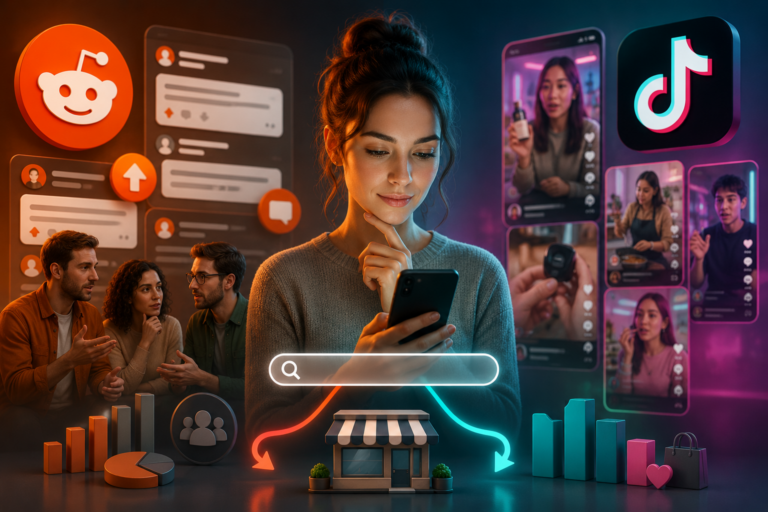

For years, getting found online meant one thing: ranking on Google. Businesses poured their energy into climbing the search results, and for a long time that was enough. But your customers no longer start every search on Google. They ask questions on TikTok, read opinions on Reddit, compare products on Amazon, watch tutorials on YouTube, and turn to AI tools for instant answers. If your visibility strategy stops at Google, you’re missing the places where buying decisions actually happen.
Search everywhere optimization is the response to this new reality. It’s the practice of making your brand visible across every platform where people search, not just traditional search engines. The term was popularized by marketer Neil Patel, who argues that SEO isn’t dead — it has simply gotten a lot bigger. Instead of optimizing for one engine, you optimize for the entire ecosystem of discovery.
At Media Components, we build integrated strategies that extend beyond rankings, combining strong search engine optimization with visibility across social, video, and emerging AI platforms. This guide explains what search everywhere optimization means, which platforms it covers, and how to put it into practice.
Key Takeaways
- Search everywhere optimization means being visible across every platform your customers use to search — not just Google.
- Search behavior has fragmented. People now research and decide across social media, video, marketplaces, forums, and AI tools.
- Each platform is its own search engine with distinct algorithms, content formats, and user intent, so a one-size-fits-all approach falls short.
- The strategy blends multiple disciplines, including SEO, social media, video, and AI visibility, into one coordinated presence.
- Measuring success requires looking beyond Google rankings to your overall share of visibility across the platforms that matter to your audience.
Why Search Is Expanding Beyond Google
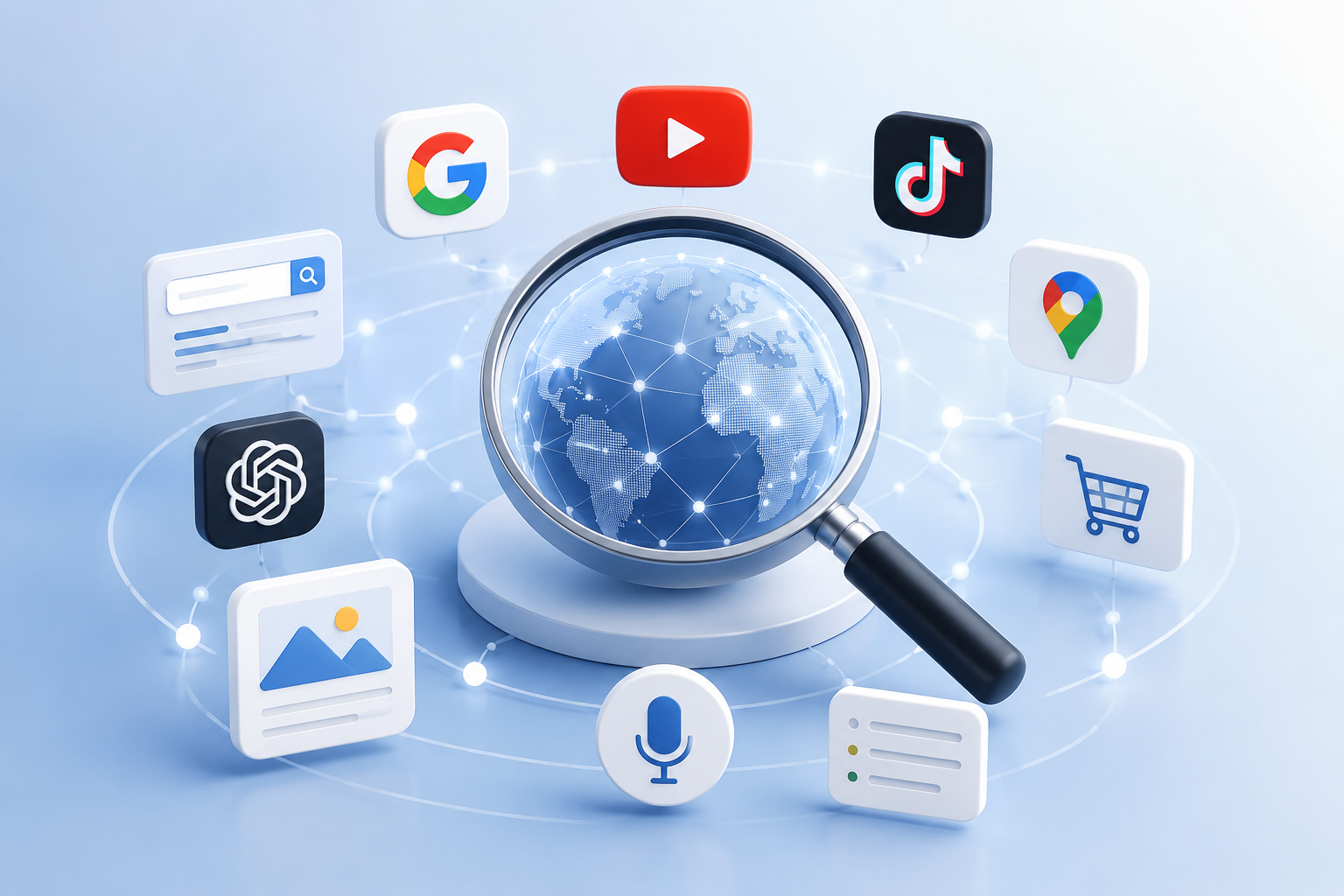
Google remains the largest search engine in the world, and traditional SEO still matters enormously. But the way people discover brands has changed faster in the past two years than in the decade before. Consumers no longer rely on one platform to research brands, compare options, or make decisions — they search across Google, TikTok, Pinterest, Instagram, YouTube, Amazon, and AI tools.
Neil Patel calls the old, Google-only mindset “the Google Trap.” The problem is that even a business ranking well on Google may be missing the decision-making moments happening on other platforms, resulting in traffic that doesn’t convert. You might be showing up in a search while your customer is actually deciding somewhere else entirely.
Two forces have accelerated this shift. First, Google itself has changed: AI Overviews now summarize answers at the top of results, and many searches end without a single click. Second, entire generations have grown comfortable searching within apps. The result is a landscape where visibility means showing up everywhere your customers already look.
Search Across Social Media and Marketplaces
The clearest evidence of this change is how people now treat social platforms and marketplaces as search engines in their own right.
- Social media has become a discovery hub. Users search TikTok and Instagram for recommendations, tutorials, and reviews, often before they ever open Google.
- Marketplaces like Amazon are where product searches frequently begin. Many shoppers skip search engines entirely and go straight to the marketplace to research and buy.
- Forums such as Reddit have become trusted research destinations, where people look for honest, unfiltered opinions from real users.
Each of these platforms functions as a search environment with its own ranking logic. That’s why understanding the full benefits of social media marketing is now inseparable from a strong search strategy — the two have effectively merged.
Platforms Included in Search Everywhere Optimization
Search everywhere optimization isn’t about being on every platform for its own sake. It’s about identifying where your specific customers search and establishing a meaningful presence there. That said, a handful of platforms now play an outsized role in discovery for most businesses.
YouTube, TikTok, Amazon, and Social Platforms
Here are the major platforms a comprehensive strategy typically considers, each serving a distinct search purpose:
- Google and Bing remain the foundation for informational, transactional, and high-intent searches, and still drive significant traffic.
- YouTube is one of the world’s most-used search engines, ideal for how-to content, in-depth explanations, and product demonstrations where people want depth.
- TikTok has become a go-to search tool for younger audiences seeking quick tutorials, reviews, and inspiration through short-form video.
- Amazon and other marketplaces are where product-focused searches and purchase decisions happen, making them essential for anyone selling products.
- Instagram and Pinterest function as visual search engines for discovery, especially for lifestyle, design, and consumer brands.
- Reddit and forums serve users looking for authentic peer opinions and detailed discussion before deciding.
- AI tools like ChatGPT and AI-powered search increasingly answer questions directly, making visibility within AI responses a growing priority.
As the traditional Google-centric search monopoly fractures into a specialized ecosystem — TikTok for tutorials, Amazon for products, Reddit for validation — brands need to optimize their presence natively across these platforms. The right mix depends entirely on your industry and audience. Socialsignalplaybook
Strategies for Search Everywhere Optimization
Expanding your visibility across platforms takes more than reposting the same content everywhere. Each platform has its own culture, format, and algorithm, so a coordinated yet tailored approach wins. This is where strong social media marketing and search expertise come together into a single, integrated strategy.
Content Distribution Across Platforms
Smart distribution means adapting your message to fit each environment rather than forcing one format everywhere. That could mean shorter video explainers for social platforms, structured question-and-answer formats for forums, and well-formatted long-form articles for web search.
Effective content distribution includes:
- Repurposing core content into platform-native formats — turning a blog post into a short video, a carousel, and a forum discussion, each shaped for its home.
- Leading with the right format on each platform, since video performs on TikTok and YouTube while structured text serves search engines and forums.
- Maintaining a consistent brand voice across platforms so customers recognize you wherever they find you.
- Encouraging authentic engagement, particularly on community-driven platforms where genuine participation builds trust and hard selling backfires.
The goal is a coordinated presence where each platform reinforces the others, guiding customers smoothly across their discovery journey.
Optimizing for Multiple Search Algorithms
Every platform ranks content differently, so optimization has to be platform-specific. What earns visibility on Google isn’t what surfaces content on TikTok or Amazon.
Key considerations include:
- Keywords and search terms matter everywhere, but how you use them differs — in captions and hashtags on social, in product titles on marketplaces, and in headings and body content for search engines.
- Engagement signals like views, comments, and shares heavily influence rankings on social and video platforms.
- Format and structure affect discoverability, from video length and retention on YouTube to clear, concise answers that AI tools can quote.
- Reviews and authority play a major role on marketplaces and in how AI systems assess trust.
For AI-driven search specifically, the guidance is to be clear and quotable. Concise answers, clean formatting, and fact-rich content help your material get surfaced and cited in generative results. Optimizing for this expanding set of algorithms is complex, which is exactly where an experienced partner earns its keep.

Measuring Visibility Across Platforms
If search now happens everywhere, success can’t be measured by Google rankings alone. A search everywhere optimization strategy requires a broader view of visibility — one that captures your presence across the full ecosystem.
Meaningful measurement focuses on:
- Share of visibility, or how often and how prominently your brand appears across the platforms your audience uses, rather than a single keyword position.
- Platform-specific metrics, such as video views and watch time, social engagement, marketplace rankings, and forum reach.
- Referral traffic and assisted conversions, which reveal how discovery on one platform contributes to action elsewhere.
- Brand searches and mentions, a strong indicator that your cross-platform presence is building awareness and demand.
- Presence in AI answers, tracking whether your content gets cited in AI-generated responses.
Because the customer journey now weaves across many platforms, attribution is more complex than it used to be. The businesses that succeed treat measurement as an ongoing process, using data from every channel to refine where they invest. While no strategy can guarantee a specific ranking or outcome, a disciplined, data-informed approach consistently builds visibility where it counts.
AI Summary
Search everywhere optimization is the practice of making a brand visible across every platform where customers search, not just Google. Popularized by marketer Neil Patel, the concept reflects how search behavior has fragmented: people now research and make decisions across social media, video, marketplaces, forums, and AI tools. Even businesses that rank well on Google can miss the decision-making moments happening elsewhere.
The strategy treats each platform — YouTube, TikTok, Amazon, Instagram, Pinterest, Reddit, and AI-powered search — as its own search engine with distinct algorithms, formats, and user intent. Success requires distributing content in platform-native formats, optimizing for each platform’s ranking logic, and being clear and quotable for AI systems. Measurement expands beyond Google rankings to overall share of visibility, platform-specific metrics, referral traffic, brand mentions, and presence in AI answers. It blends SEO, social media, video, and AI visibility into one coordinated presence. Media Components builds these integrated strategies for businesses nationwide from its offices in Huntingdon Valley, PA and Boca Raton, FL.