


Most businesses focus on driving more traffic — but the real opportunity often lies in converting the visitors you already have. Implementing the right CRO strategies can dramatically increase revenue without increasing your ad spend. This guide breaks down the most effective approaches used by high-performing digital teams today.
Regardless of your business type, your website’s design and development choices directly impact how many visitors convert to customers.
What Conversion Rate Optimization (CRO) Means
Conversion rate optimization (CRO) is a systematic approach to increasing the percentage of website visitors who complete a desired action, such as submitting a form, making a purchase, or booking a call. The conversion rate is calculated as follows:
Conversion Rate = (Conversions ÷ Total Visitors) × 100
CRO relies on a structured, data-driven process that uses behavioral research, analytics, and iterative testing to determine effective strategies. The objective is to align your website’s design and messaging with your audience’s needs.
It’s also important to understand what conversion rate optimization is in practical terms: it’s not just about design tweaks. It encompasses everything from your copy and calls-to-action to your page load speed and checkout flow.
| Metric | What It Measures |
|---|---|
| Conversion Rate | % of visitors completing a goal |
| Bounce Rate | % of visitors leaving after one page |
| Click-Through Rate (CTR) | % of users clicking a CTA or link |
| Average Session Duration | Time spent engaging with content |
| Revenue Per Visitor | Average value generated per visit |
Core CRO Strategies
A successful CRO process begins with a clear framework — not random changes. Before making any modifications to your site, you need a structured hypothesis, a testing plan, and measurable success criteria.
The full range of digital services at a performance-focused agency typically integrates CRO into web development, paid media, and content strategy from day one. CRO isn’t a one-time audit — it’s an ongoing practice.
Here are the foundational conversion rate optimization strategies proven to deliver results:
- Simplify the conversion path: eliminate unnecessary steps between visitor intent and the desired action.
- Strengthen your value proposition: clearly communicate why your offer is the best choice.
- Improve page load speed: even a one-second delay can reduce conversions by 7% (Google research).
- Use social proof: testimonials, case studies, and review counts build credibility and reduce hesitation.
- Optimize CTA placement and copy: action-oriented, benefit-driven CTAs consistently outperform generic options such as “Submit.”
- Design for mobile-first: over 60% of web traffic originates from mobile devices.
- Reduce form fields: shorter forms lead to significantly higher completion rates.
A/B Testing, Multivariate Testing, User Journey Analysis
A/B testing compares two versions of a page element, such as a headline, button, or image, to determine which performs better with users. It is an accessible starting point for most teams and yields statistically reliable results when executed properly.
Multivariate testing evaluates multiple variables simultaneously across a page. While it requires more traffic to achieve statistical significance, it reveals how combinations of elements interact, providing insights beyond those from A/B testing.
User journey analysis tracks how visitors navigate your site before converting or leaving. Identifying drop-off points in the funnel helps prioritize which pages or steps require the most attention. Tools such as Google Analytics 4, Hotjar, and FullStory are commonly used for this analysis.
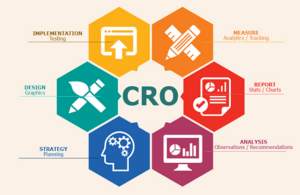
Identifying Friction Points
Friction refers to anything that slows, confuses, or discourages visitors from converting. It may be structural, psychological, or technical. Reducing friction is often the most impactful CRO strategy.
Common friction points include unclear navigation, ambiguous CTAs, excessive form fields, slow page speeds, and insufficient trust signals such as security badges or guarantees.
Heatmaps, Scroll Tracking, Behavioral Insights
Heatmaps visually display where users click, move their mouse, and focus attention on a page. They help identify mismatches, such as users clicking on a non-linked image they believe is a button.
Scroll tracking reveals how far visitors read down a page. If most users do not reach your primary CTA because it is below the scroll depth of 60% of visitors, this insight can be acted upon immediately.
Behavioral insights bring both data sources together with session recordings and funnel analysis. According to Nielsen Norman Group research, users read only about 20% of the text on a given page — which means content positioning and visual hierarchy are critical to keeping attention and driving conversions.
Improving Landing Page Performance
Landing pages offer the greatest leverage in your conversion funnel. An optimized landing page eliminates distractions, aligns the headline with the referring ad or link, and emphasizes a single, clear call-to-action.
Key elements of a high-converting landing page include:
- A benefit-driven headline that matches visitor intent
- A concise subheading that reinforces the core offer
- One prominent, above-the-fold CTA button
- Supporting proof elements (testimonials, logos, data)
- A distraction-free layout with minimal navigation
- Mobile-optimized design and fast load performance
Page-level conversion rate optimization tips that consistently make measurable differences: reducing visual clutter, using directional cues (arrows, imagery) to guide the eye toward the CTA, and testing headline variants regularly. Even small copy changes — swapping “Get a Quote” for “See My Custom Plan” — can lift conversion rates by double digits.
Personalization and Audience Segmentation
Generic experiences yield generic results. Personalization enables you to deliver tailored content, offers, and messaging to specific audience segments, which significantly increases relevance and conversions.
Effective personalization begins with segmentation, dividing your audience by behavior, demographics, traffic source, or stage in the buying journey. For example, a first-time visitor from a paid search ad should have a different experience than a returning user who has viewed your pricing page.
A clear understanding of content personality and brand identity is essential for effective personalization. Your content should maintain a consistent voice while adapting its emphasis as needed.

Tailoring Content and Offers to User Intent
User intent indicates what a visitor aims to achieve. For example, someone searching “best CRM for small business” is researching, while someone searching “buy CRM software” is ready to convert. These visitors should not encounter the same page or message.
Personalization tactics that work at scale:
- Dynamic headlines that reflect the visitor’s search query or traffic source
- Geo-targeted offers for location-specific pricing or availability
- Behavior-triggered popups are shown only to users who have spent a defined amount of time or viewed specific pages
- Returning visitor overlays that reference previous interactions or pages viewed
When implemented effectively, personalization consistently improves engagement metrics and reduces bounce rates. According to McKinsey, companies that excel at personalization generate 40% more revenue than average competitors.
How to Measure CRO Success
CRO efforts are only as effective as your ability to measure them accurately. Without a proper measurement framework, you risk focusing on the wrong metrics or misattributing results.
Key metrics to track include overall conversion rate (by page and goal), micro-conversion rates (such as email sign-ups, video views, or add-to-cart actions), revenue per visitor, cost per acquisition (CPA), and the statistical significance of test results.
It is essential to set a testing duration before launching experiments. Ending a test early due to positive trends is a common and costly CRO mistake. Most reliable tests require at least two business cycles (typically two weeks) and a statistically significant sample size for trustworthy results.
Performance measurement should also consider audience segments. For example, a 3% overall conversion rate may hide that mobile users convert at 1.5% while desktop users convert at 5%, which are distinct issues requiring different solutions.